About
About Me
I’m an experimental physicist working at the intersection of particle physics and cosmology, where I build and study ultra-sensitive instruments designed to probe some of the most fundamental questions we can ask about the universe: What is it made of? How did it begin? And what laws govern it at the deepest level?
While the science I work on can feel abstract, my path into physics has always been rooted in building real things and seeing ideas move from paper to hardware.
How I fell in love with physics
My interest in physics began in high school, where I was part of the Dos Pueblos Engineering Academy with an inspiring physics teacher who emphasized learning by doing. Through that program, I joined the FIRST Robotics Competition (FRC) .
That experience was transformative. It showed me how powerful it can be to take an abstract idea, turn it into a physical system, and then push that system until it works under real-world constraints.
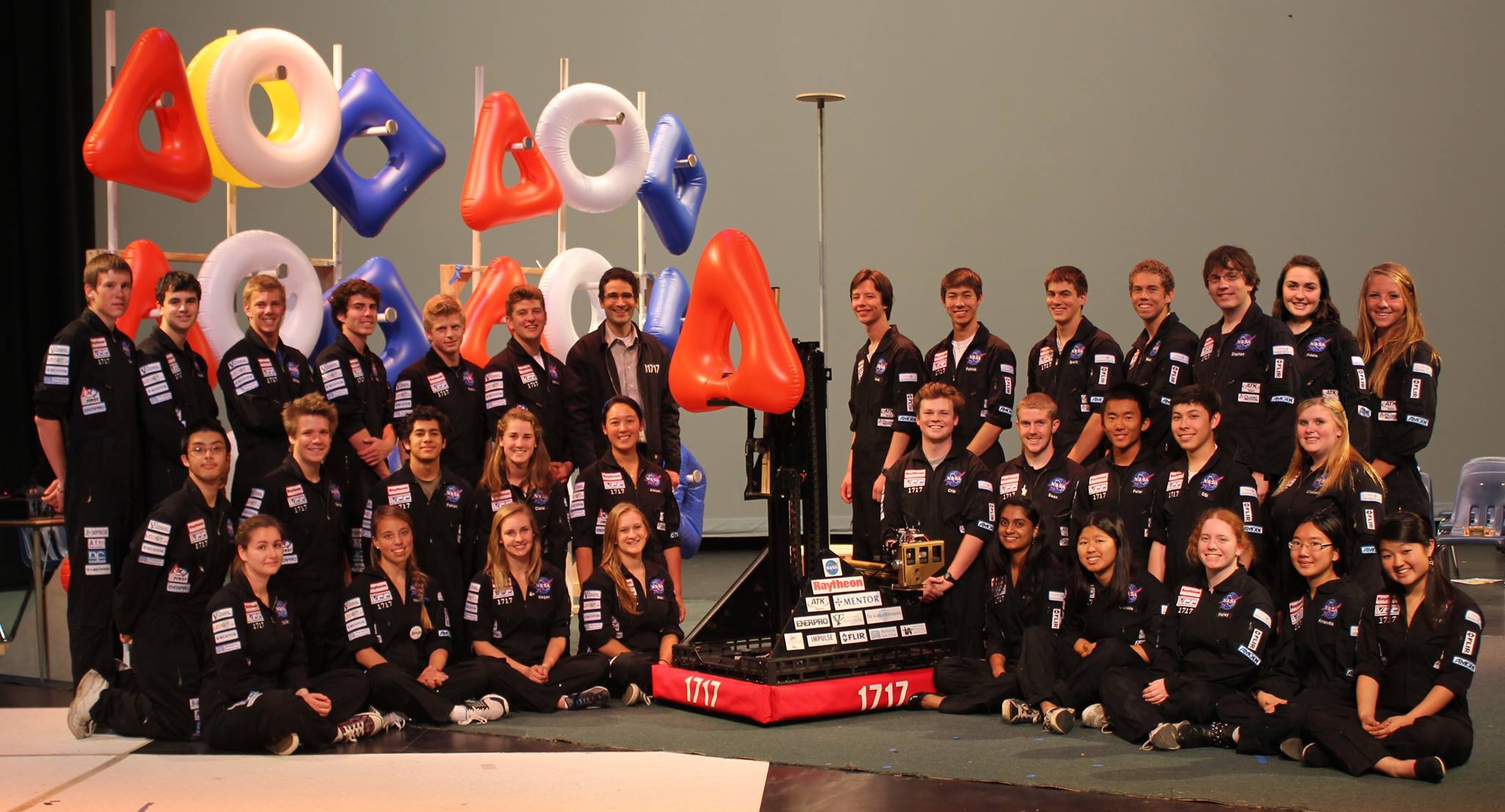
My FRC team and robot (Team 1717). Can spot me in the upper right.
Discovering the joys of experiment
When I arrived at college at Santa Clara University (Go Broncos!), an exceptional physicist, Betty Young, introduced me to laboratory research, and I quickly realized that physics could be even more creative than robotics. Research felt like engineering on steroids: instead of solving a predefined problem, you start by asking a deep question about nature and then invent the most clever, sensitive, and reliable way to answer it.
I was especially drawn to experimental work, where understanding the underlying physics is inseparable from how you design the measurement. The challenge isn’t just what you want to measure—it’s how you can possibly measure something so small, faint, or rare that it sits right at the edge of detectability.

Me with the first experiment I designed and built--the DM Radio Pathfinder.
Quantum sensors, cosmology, and big questions
After completing my undergraduate degree, I spent time in a post-baccalaureate research position at Stanford in the Kent Irwin’s where I became fascinated by quantum sensors and readout systems—devices that operate near fundamental limits set by quantum mechanics itself. That work introduced me to the field of cosmic microwave background (CMB) experiments and precision cosmology.
What struck me immediately was the scale of the questions we could try to answer. By building extraordinarily sensitive instruments, we can learn about the universe when it was only a few hundred thousand years old, test ideas about cosmic inflation, and search for new forms of matter that have never been directly detected.
I went on to earn my PhD, focusing on experimental instrumentation, detector readout, and noise characterization for large-scale physics experiments. Today, as a postdoctoral researcher, my work spans two closely related areas:
- Axion dark matter detection, through experiments like HAYSTAC and ALPHA, where I work on resonant RF cavities, and quantum-limited or quantum-enhanced readout.
- CMB instrumentation and analysis, primarily with the Simons Observatory, where I focus on detector and readout performance, time-ordered data processing, noise modeling, and analysis pipelines in support of our inflationary B-mode search.
Why I love this kind of science
The questions I work on aren’t always directly impactful in an everyday sense. I’m not designing a medical device or a consumer product—and that isn’t really the point. Basic research is about asking questions that humans seem almost compelled to ask: Where did we come from? What is the universe made of? Why does it behave the way it does? In that sense, I think basic research is closer to art or philosophy than to applied engineering. It’s a reflection of a very human impulse to ponder, create, and understand.
The fact that basic research often leads to transformative technologies (the internet being a well-known example) is a remarkable and valuable secondary outcome. But even without those downstream impacts, I believe this work is worth doing. It allows us to engage with some of the deepest questions we can ask as a people, while still inventing and building real physical systems that have to work. That combination of intellectual freedom paired with hands-on creation is what makes this work so beautiful to me.
Beyond research
Outside the lab, I love to read fantasy and sci-fi novels, travel to explore new cities, food, and wine, and spend as much time at the beach in the sun as I can! I enjoy collaborating closely with students, building open and reusable scientific software, and working on side projects that blend design, making, and creativity. I care deeply about mentorship and about making large scientific collaborations function smoothly and transparently.
If you’d like to learn more, you can explore:
- Research — an overview of the science questions and experiments I work on
- Projects — specific research and side projects
- Talks & Videos — recorded talks, presentations, and media
- CV & Publications — a full list of my academic work
I’m always happy to hear from students, collaborators, or anyone curious about experimental physics and cosmology.